How Proper Gutter Installation Prevents Costly Home Water Damage?
June 27, 2026
You noticed it after the last heavy rain. A brown stain creeping down the interior wall near your window, or maybe a puddle forming along the base of your foundation where there should not be one. You checked the roof, and it looks fine. What you probably have not checked yet is whether your gutters are actually doing their job.
Gutters fail quietly. They do not collapse overnight or announce a problem with a loud noise. They simply stop directing water where it needs to go, and over months of Alabama rainfall, that misdirected water finds the path of least resistance straight into your home. The single most important thing to understand is this: a gutter system that is improperly pitched, undersized, or incorrectly fastened is not just useless. It is actively directing water toward your structure instead of away from it.
What Most Homeowners Get Wrong About Gutters
Most people assume gutters are either working or visibly broken. If water comes out of the downspout, the system must be fine. That assumption causes the majority of preventable water damage we see on service calls across Mobile.
The real issue is pitch. Gutters must slope toward the downspout at a rate of roughly one-quarter inch for every 10 linear feet. When gutters are installed level or with an incorrect pitch, water pools inside the channel. Pooled water adds weight, accelerates corrosion, and eventually overflows or seeps behind the fascia board. On a 40-foot gutter run with even a slight reverse pitch, you can have two to three gallons of standing water after a single storm.
A second common error is downspout placement. Industry standard calls for one downspout per 30 to 40 linear feet of gutter on a straight run. When downspouts are spaced too far apart, even a properly pitched gutter overwhelms during high-volume rain events. Mobile averages over 60 inches of rainfall annually, well above the national average of around 38 inches, which means undersized or under-drained systems here fail far faster than they would in drier regions.
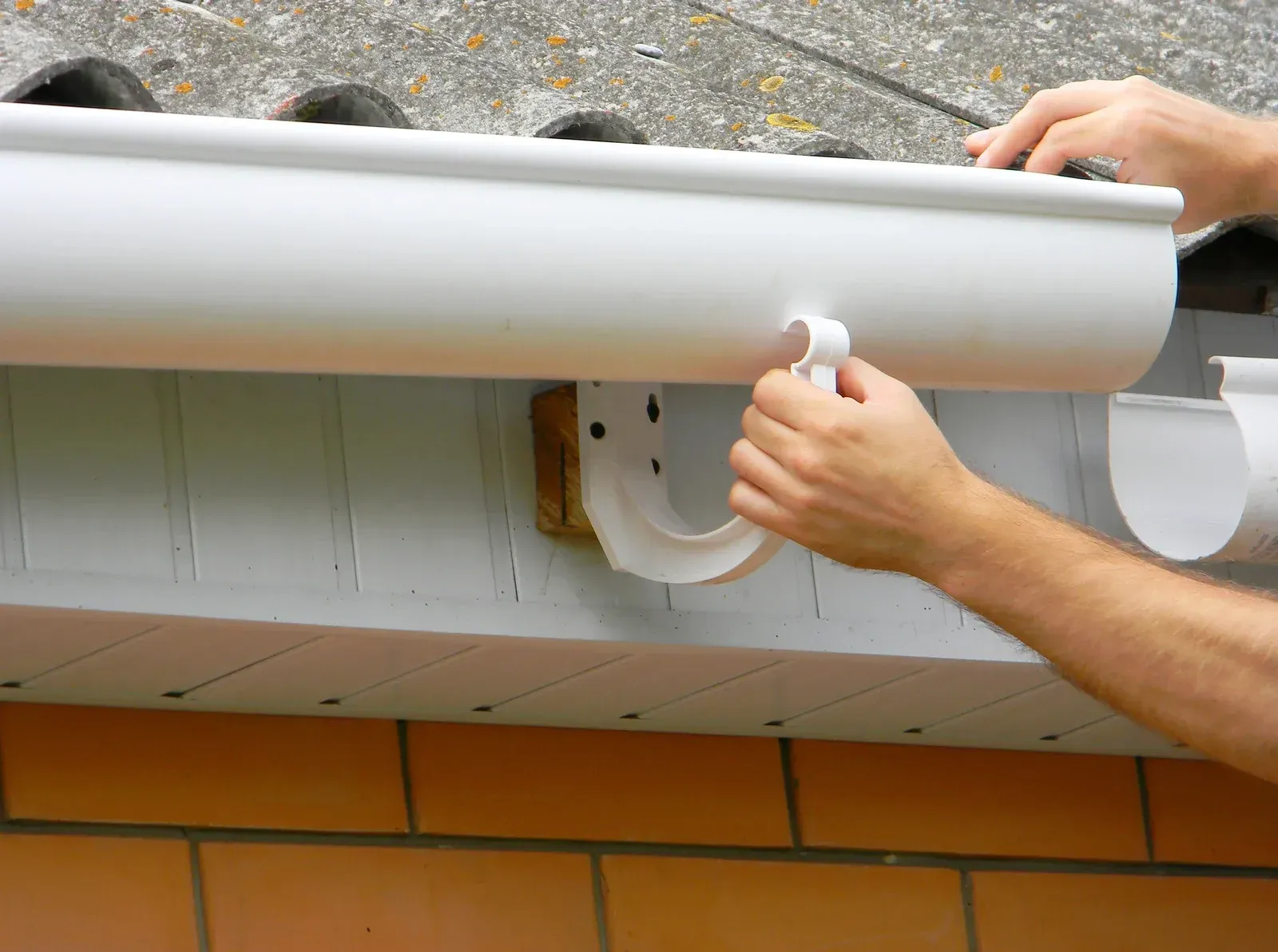
Gutter hangers are the third overlooked factor. Hangers placed more than 24 inches apart allow the gutter to flex under water load. Over time, that flex widens the seams, pulls the back edge away from the fascia, and creates a gap where water runs directly behind the gutter and onto the siding or into the wall cavity.
Gutter Problem Diagnostic Table
| What You Are Seeing | Most Likely Cause | Severity | First Step to Take |
|---|---|---|---|
| Water overflowing over the front lip | Gutters pitched too flat or clogged | High | Check pitch with a level; clear debris |
| Water running behind the gutter | Back edge separated from fascia | High | Inspect hanger spacing and fascia condition |
| Pooling water near foundation | Downspout discharges too close to home | High | Extend downspout at least 6 feet from foundation |
| Rust stains or streaks on siding | Standing water in gutter channel | Medium | Inspect pitch; check for sagging sections |
| Dripping at gutter joints | Failed sealant or improper overlap | Medium | Reseal or replace section; check overlap direction |
| Gutters pulling away from roofline | Hanger failure or rotten fascia | High | Inspect fascia board before re-securing hangers |
| Water marks on basement or crawl space walls | Inadequate downspout extension | High | Reroute downspout away from foundation |
| Granules accumulating in gutters | Aging shingles shedding material | Low | Monitor shingle condition; schedule roof inspection |
| Ice damming at gutters in winter | Poor attic insulation or ventilation | Medium | Address attic before assuming gutter problem |
| Paint peeling near roofline | Moisture wicking into fascia from pooled gutters | Medium | Inspect fascia and correct gutter pitch |
How We Diagnose Gutter Problems in the Field
When we inspect a gutter system, we start with the fascia board before we touch the gutter itself. Rotten or soft fascia is the most common finding on service calls in Mobile, and it tells us the problem has been building for months or years. You cannot properly anchor a gutter to compromised wood, and re-hanging a gutter on a rotten fascia just delays the same failure by a season.
After the fascia, we check pitch using a 4-foot level along multiple points of the run. We also mark any low points where water sits after rain. Then we trace each downspout to where it terminates. In Mobile's older neighborhoods, we frequently find downspouts dumping water directly against brick foundations or into underground drains that have not been cleared in years. Both situations create hydrostatic pressure against the foundation that compounds over time.
We also measure gutter width against the roof's drainage area. A 4-inch gutter on a wide roof plane with a steep pitch is undersized for the volume of water it needs to handle during a Gulf Coast storm cell. Per industry standards, a 6-inch K-style gutter handles roughly 50 percent more water volume than a 4-inch profile and is the correct choice for most homes in this region.
Repair vs. Replace: What Makes Sense for Your Gutters
Not every gutter problem requires full replacement. Here is how to evaluate your options honestly.
Repair makes sense when:
The fascia board is solid, the gutter profile is intact, and the failure is isolated to a joint, a single section, or hanger spacing. Re-pitching a sagging run, replacing a section, and adding hangers are all reasonable repairs on a system under 10 years old with no widespread corrosion.
Replacement makes sense when:
The system is 20 or more years old, multiple seams are failing, the fascia has water damage in more than one location, or the gutter width is undersized for the roof. In Mobile, aluminum gutters have a functional lifespan of 20 to 30 years depending on maintenance. Galvanized steel gutters in this coastal environment corrode faster due to salt air and typically need replacement closer to the 15-year mark.
| Factor | Repair | Replace |
|---|---|---|
| System age under 10 years | Preferred | Usually not needed |
| Isolated section damage | Yes | No |
| Widespread seam failures | Temporary | Recommended |
| Rotten fascia in multiple areas | Address separately | Recommended alongside |
| Undersized gutter profile | Not solvable by repair | Replace with correct size |
| Salt air corrosion present | Short-term only | Preferred with corrosion-resistant material |
Gutter Maintenance by Season
Monthly during storm season (June through October):
Clear visible debris from gutters and downspout openings after any significant storm. Check that downspout extensions have not shifted.
Quarterly:
Run a hose through each downspout to confirm clear flow. Inspect joints and end caps for seeping water.
Annually (ideally late fall after leaves drop):
Full gutter flush, pitch check, hanger inspection, and fascia assessment. This is the most important maintenance interval for Mobile homeowners because winter rain follows immediately after leaf drop.
Every 3 to 5 years:
Reseal all interior joints with appropriate gutter sealant. In Mobile's humidity and heat, sealants break down faster than in cooler climates and this interval prevents most joint failures before they develop into fascia damage.
Common Mistakes That Make Gutter Problems Worse
Installing gutter guards without fixing the underlying pitch problem
Gutter guards reduce debris accumulation, but they do nothing for a system that is already pitched incorrectly. We frequently find homes with guards installed over gutters that are still pooling water beneath them.
Re-hanging gutters without replacing rotten fascia
It is tempting to just re-screw a sagging gutter, but if the wood behind it has lost structural integrity, the new fasteners will not hold through the next storm season.
Assuming a clog is the whole problem
Clearing a blockage and seeing water flow again does not mean the system is correctly installed. A gutter can drain and still be pitched in a way that leaves 30 to 40 percent of its channel volume as standing water after every rain.
FAQ's
How do I know if my gutters are pitched correctly without measuring tools?
After 48 dry hours, run a garden hose at the high end of your gutter run. Water should travel the full channel length and exit the downspout within seconds. Pooling or slow movement at any point indicates insufficient pitch in that section.
Can improperly installed gutters cause foundation damage?
Yes, and it ranks among the most serious consequences of a failing gutter system. Downspouts discharging too close to your foundation saturate surrounding soil repeatedly. Over time, that moisture creates hydrostatic pressure against the foundation, leading to cracking, shifting, and crawl space or basement intrusion.
How often should gutters be replaced in a coastal climate like Mobile?
Aluminum gutters in Mobile perform well for 20 to 25 years with consistent maintenance. Galvanized steel corrodes faster in salt-influenced air and typically needs replacement around 15 years. Seamless aluminum with a painted finish outlasts sectional gutters by eliminating the joint failures that accelerate corrosion here.
Is it safe to clean gutters myself?
Single-story gutter cleaning with a stable ladder and a spotter present is reasonable for most homeowners. Avoid multi-story work, gutters near power lines, or steep and wet rooflines. Falls from ladders cause a significant share of home improvement injuries annually, and wet conditions make footing unpredictable.
What size gutters do most Mobile homes need?
Most Mobile homes with standard roof pitches perform better with 6-inch K-style gutters than the 4-inch profiles common on older homes. Mobile's high annual rainfall and intense storm frequency regularly exceed what 4-inch systems handle, causing overflow and the structural water damage that follows.
Expert Gutter Installation Mobile Homeowners Rely On
Misdirected water is the root cause of more preventable structural damage than almost any other residential maintenance failure, and in a climate that delivers over 60 inches of rain per year, the margin for error in your gutter system is slim. Mobile's combination of tropical moisture, intense summer storms, and year-round rainfall means a gutter system that is borderline functional elsewhere becomes actively damaging here within a single wet season.
Top Flight Roofing
has spent more than 10
years inspecting, installing, and repairing gutter systems. We assess pitch, fascia condition, downspout placement, and system sizing on every inspection because those are the factors that determine whether your gutters protect your home or silently work against it. If your last heavy rain left you with questions about what your gutter system is actually doing, our
professional gutter installation services
provide the quality workmanship and dependable protection your home deserves.